
The Jüdenberg in Meissen
The Beginnings of Jewish Life in Saxony
Why is there a Jüdenberg in Meissen, and where can traces of Jewish life still be found in the town today?
.png)

.jpg)

Beginnings
Jews have lived in what is now Saxony for over 900 years. Early settlements are recorded in Meissen, Freiberg, Torgau, Zwickau, Leipzig and Dresden. Working as traders, butchers or moneylenders, they maintained their own communities with synagogues and cemeteries.
The oldest traces of Jewish life in Saxony are found in Meissen. Jews are mentioned in documents as early as the 11th century. Little is known about the size of the community, but it possessed its own synagogue, richly decorated inside, as reported by Rabbi Isaak ben Mose, who later lived in Vienna. As a child, he had prayed in this synagogue.
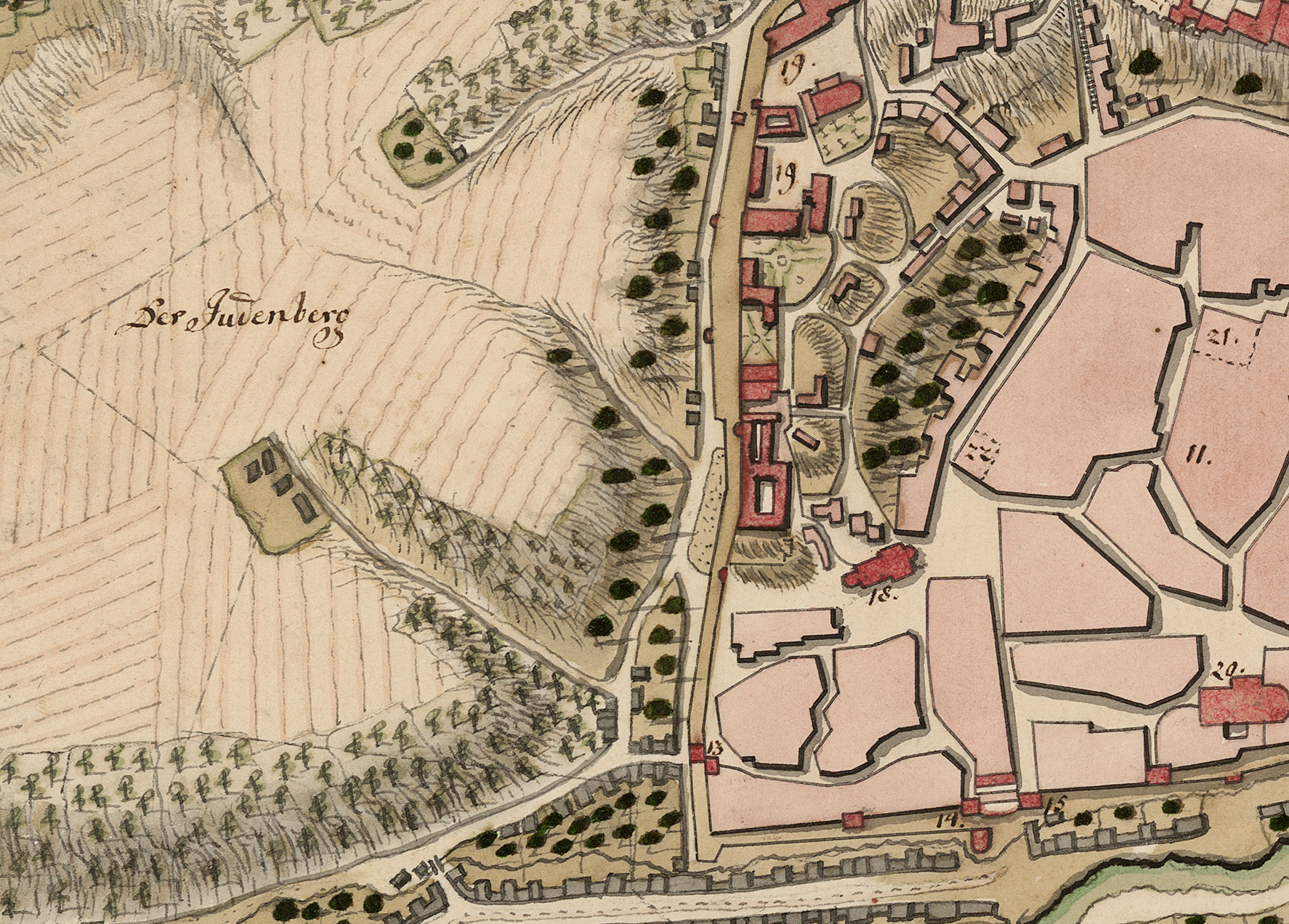
In Meissen, unlike in other places, Jews were also permitted to work as butchers. Their trading posts were located at the southern end of the town, near the city walls. The butcher’s stalls in Meissen are first mentioned in 1287. This was also where the stalls of the Christian butchers’ guild were situated, as indicated by the street name ‘Fleischer-Gasse’. A town map from 1832 shows a “Jüden-Gasse” in the immediate vicinity of the butcher’s stalls. (Image 1) In the Middle Ages, there were also two city gates there: the Fleischer-Tor and the Jüdentor. The latter was presumably the only entrance to the city through which Jews were permitted to pass. The gate is marked on a town map from 1760. ("No. 15", bottom right, Image 2)
The exact location of the synagogue, and thus the centre of Jewish life, has not been conclusively established. Documents relating to rent payments and land matters suggest that the synagogue stood south of the Old Town, near Neumarkt. In the Margraviate of Meissen, however, Jews were able to live with relative freedom. They were not subject to any dress codes, such as a yellow cloth or the ‘Jewish cap’, which were mandatory in other regions. Certain aspects were regulated in a ‘Jewish Ordinance’ issued by Margrave Henry the Illustrious in 1265.
Jüdenberg
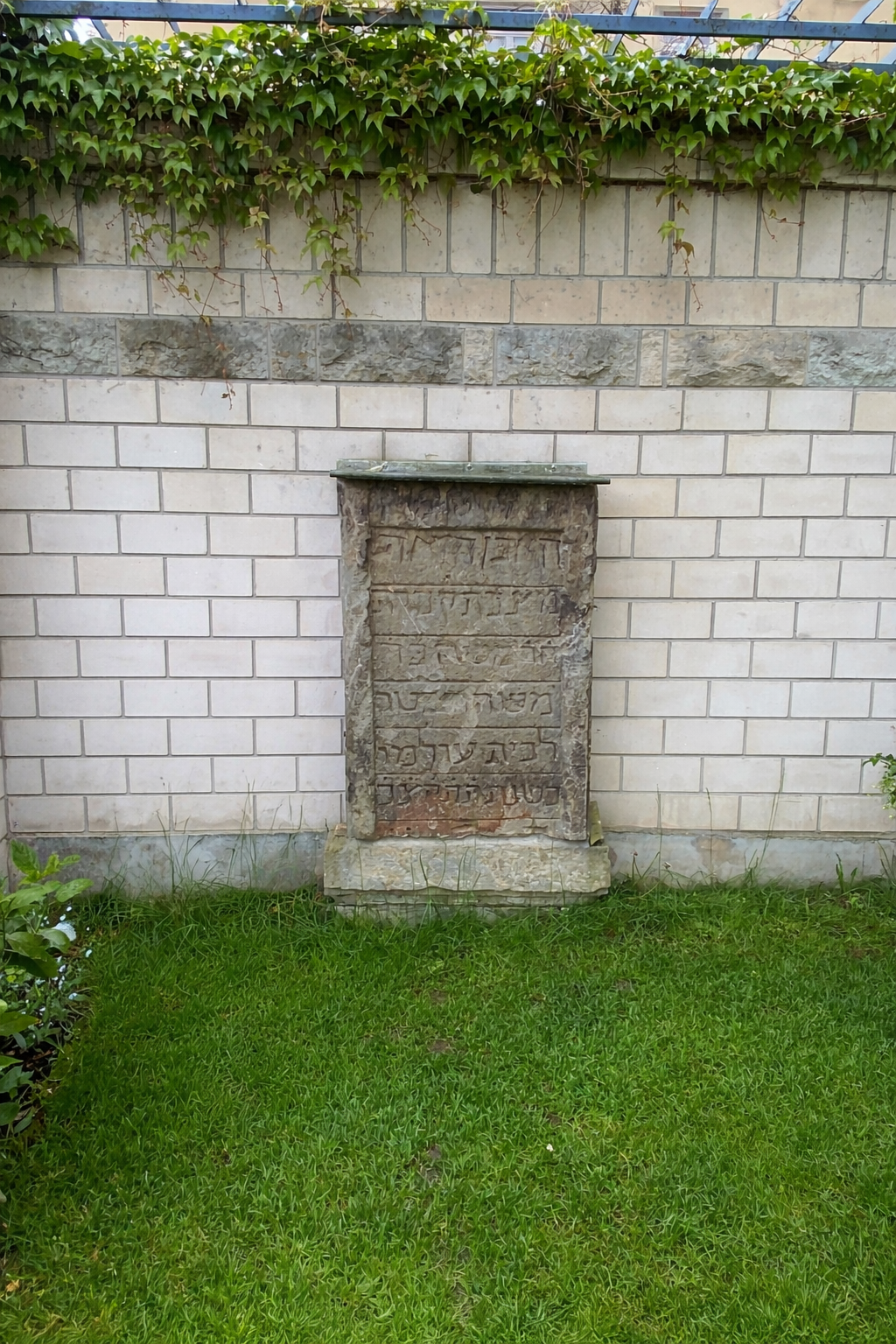
The Jewish cemetery was situated on a hill to the west of what is now the old town. The name ‘Jüdenberg’ is first mentioned in a document dating from 1286. However, there is also a gravestone in Meissen dedicated to a man named Moses and dated 1232. The stone now stands on private property (Image 3). It is no longer possible to say exactly how large the cemetery actually was.
During Shrovetide 1349, the Jewish inhabitants of Meissen were expelled or murdered. Pogroms of this kind occurred throughout Europe during the Plague (1348–1350), including in Germany. In Meissen, it is striking that the expulsion and murder took place even before the outbreak of the plague in the town, presumably due to anti-Jewish prejudice and also the desire of the Meissen population to eliminate economic competition.
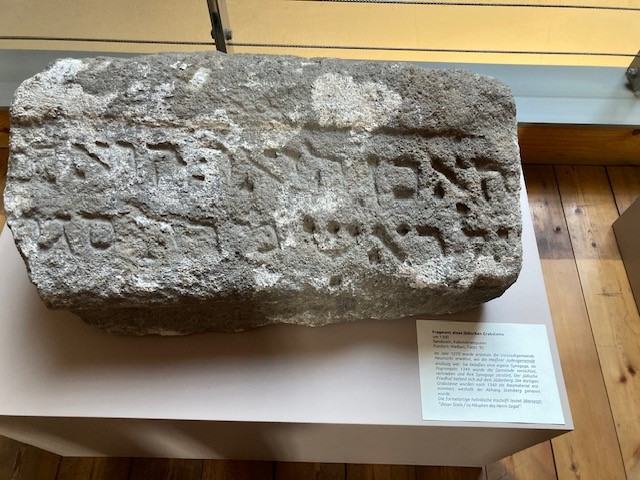
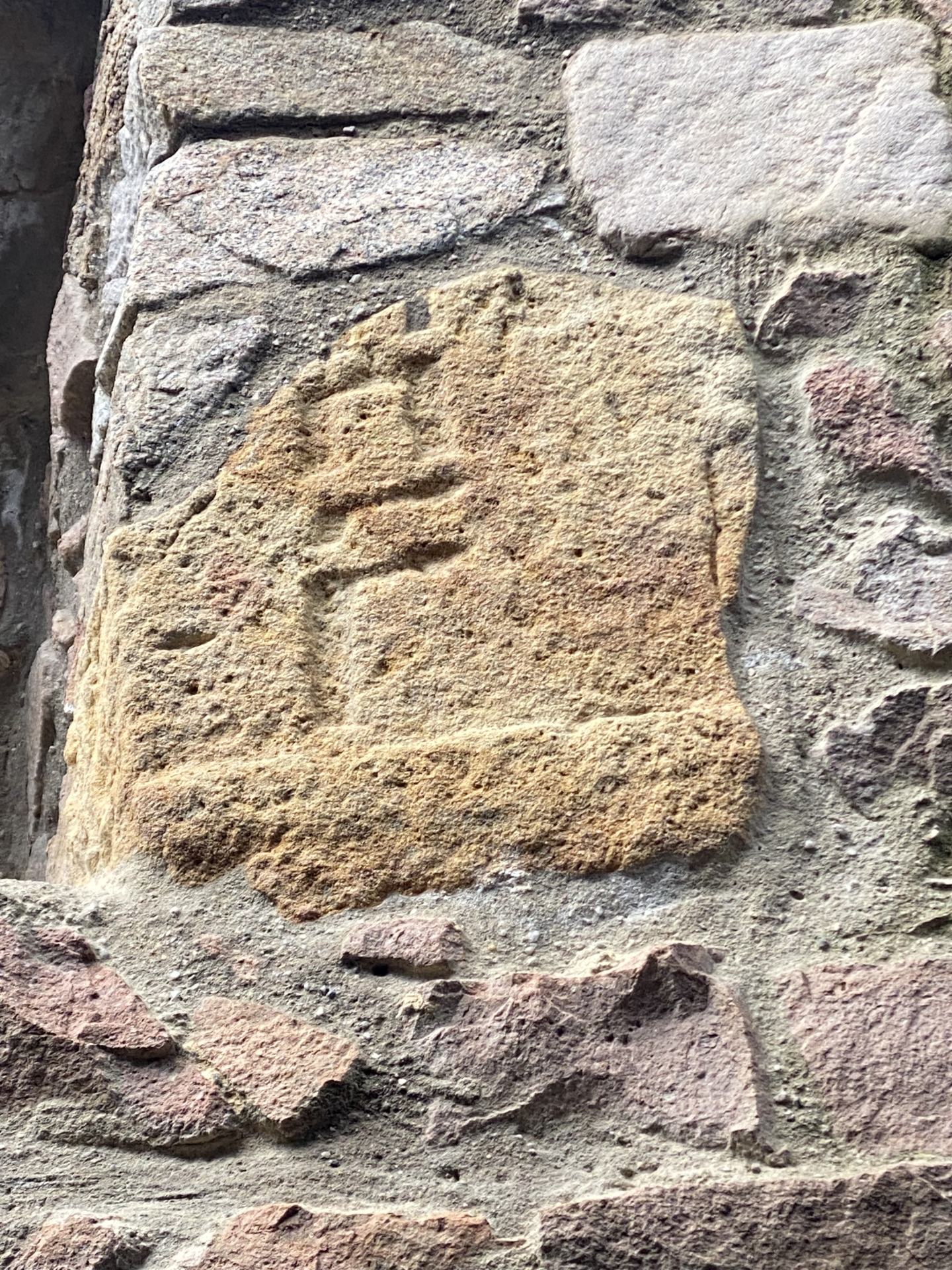
This is also supported by the fact that Jewish settlements were swiftly razed and taken over following the pogrom. As early as 7 March 1349, the Margrave granted the ‘Judenberg’ to the town and its citizens for their own use, including as a ‘pasture’ (Image 4). In the process, the Jewish cemetery and most of the gravestones were destroyed. Individual fragments of gravestones are now housed in the Meissen City Museum (Image 5). Other stones were incorporated into buildings and can be found in the cellars of houses in the old town or in a section of the old city wall near the former St. Afra Convent (Image 6).
A document from 1377 also attests that the synagogue and other Jewish sites had been transferred. In it, the abbess of the Convent of the Holy Cross confirmed that the town’s ‘Jewish houses’ and the ‘Jewish school’ (i.e. the synagogue) had been transferred to St. Nicolai Church (Image 7). Following the plague pogrom, Jews had briefly returned to live in Meissen, but establishing a permanent community structure remained impossible.
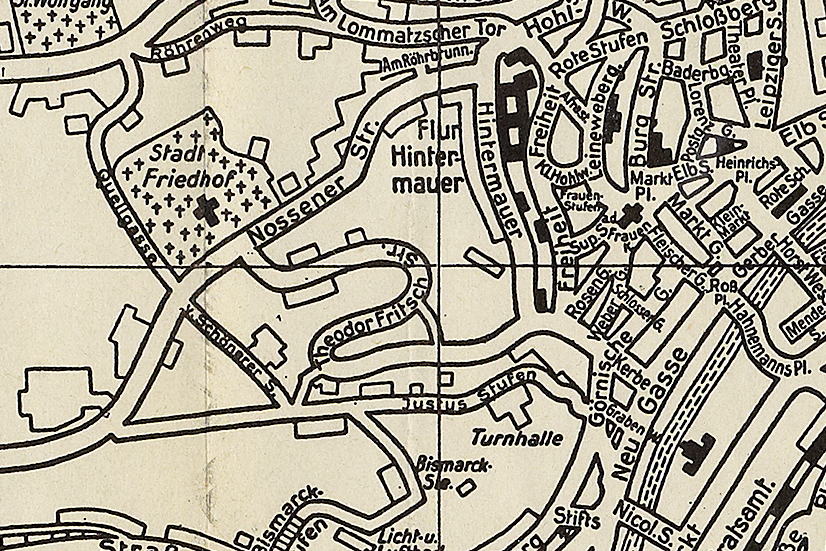
The name “Jüdenberg”, however, remained and served as a reminder of the time when Jews lived in the town. It was not until the Nazi era that attempts were made to change this. In 1937, Jüdenbergstraße was renamed “Theodor-Fritsch-Straße” after the völkisch-antisemitic writer. The steps were also named after him (Figures 8 and 9).
On 16 May 1945, following the end of the war, the street was renamed. To this day, Jüdenbergstraße remains in Meissen, commemorating the earliest Jewish settlement in Saxony.
(Alexander Walther)
GND: 4038474-3
Source:
- Donath, Christiane: Misnia Judaica - Mittelalterliche hebräische Grabinschriften in Meißen und die Geschichte der Juden in der Mark Meißen bis zum 15. Jahrhundert, in: Arbeits- und Forschungsberichte zur sächsischen Bodendenkmalpflege, Bd. 46 (2004), S. 391-484.
- Christl, Andreas: Die Meißner Judengemeinde im Mittelalter: Sachzeugen und Schriftquellen im Kontext, in: Mitteilungen der Deutschen Gesellschaft für Archäologie des Mittelalters und der Neuzeit, Bd. 23 (2011), S. 219-225.
- Lämmerhirt, Maike: Juden in den wettinischen Herrschaftsgebieten. Recht, Verwaltung und Wirtschaft im Spätmittelalter, Köln/Weimar/Wien 2007.