
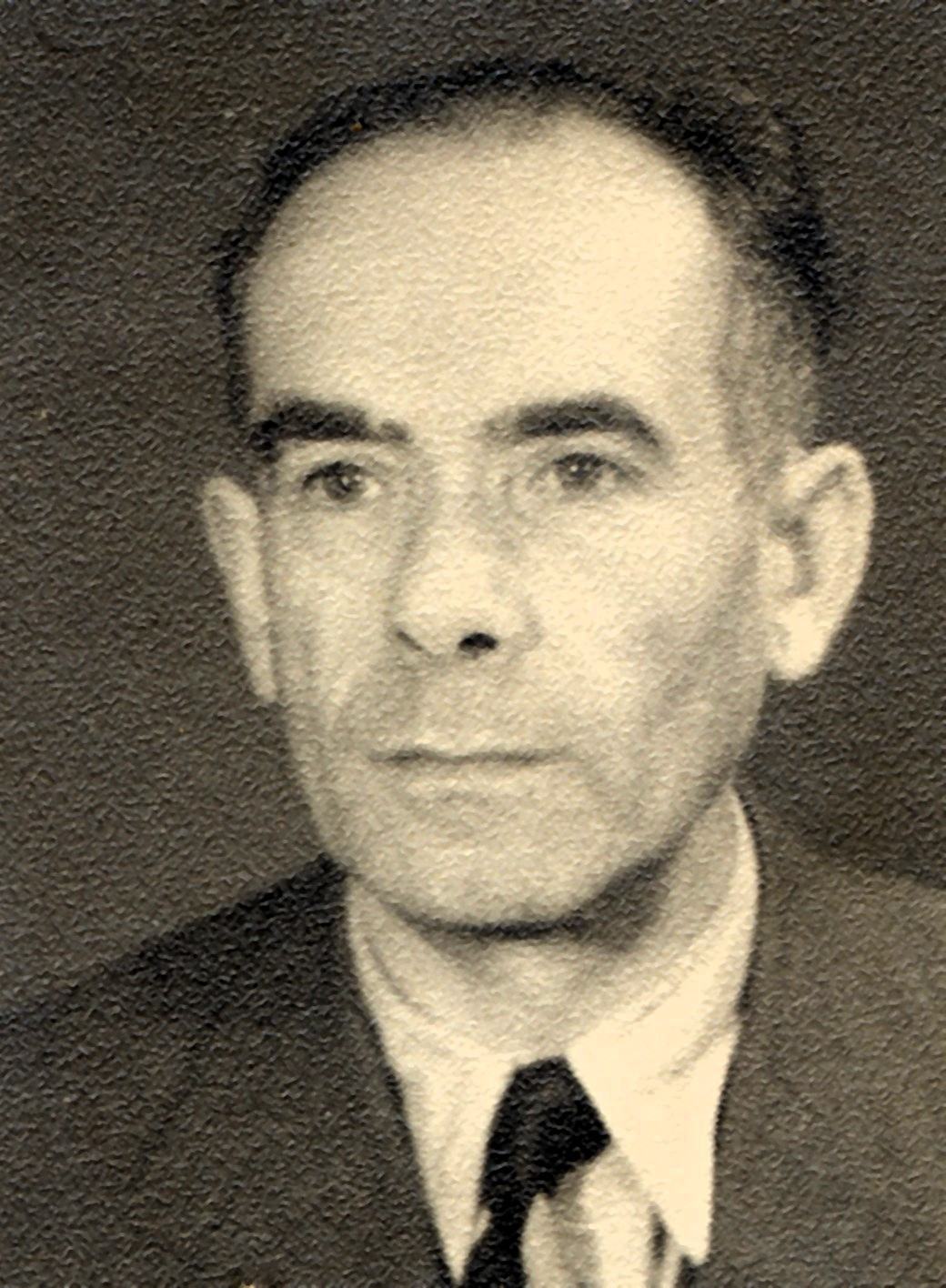
Siegbert Fechenbach
Organiser of the Re-Establishment
* 06.09.1892 in Bad Mergentheim (Baden-Württemberg)
✡ 27.11.1967 in Berlin (West)
Life and Work
Siegbert Fechenbach grew up in Bad Mergentheim with his parents, Noe Fechenbach (a master baker) and Rosalie Weikersheim, and several siblings. After attending secondary school, he lived in Würzburg until the end of 1912. He then served temporarily as a department manager at the Gebrüder Kahn hosiery factory in Chemnitz. In 1914, he served in the First World War as a musketeer in the army, was wounded and ended up in a military hospital in 1915, where his right lower leg was amputated.
After the war, on 27 April 1918, he married Anna Voigt from Brandenburg, with whom he had a son. At the same time, he worked as an authorised signatory for the Sussmann Brothers Hosiery Factories in Chemnitz and Meinersdorf (Burkhardtsdorf). During the November Revolution of 1918–19, he was a member of the Workers’ and Soldiers’ Council in Chemnitz, head of the Economic Office within the Workers’ Council, and a member of the SPD. In 1919–20, he was a trade union official for the Central Association of Employees.
From January 1920 to 1922, he was the first managing director of the Schocken Brothers’ department store in Chemnitz and became a member of the executive committee of the Jewish Religious Community.
Buchenwald
In the spring of 1933, Fechenbach was placed in “protective custody” for three weeks, presumably at Kaßberg Prison. During the November pogroms of 1938, he was arrested and sent to Buchenwald concentration camp, where he remained until 26 November 1938. His business licence was revoked and his plans to emigrate to the USA or England came to nothing.

Surviving in Chemnitz
In 1939, he was forced to move to the “Judenhaus” at 6 Zöllnerstraße. From July 1941, he worked as a community and religious assistant and as a stoker for the Jewish Cultural Association; from March 1942, he was forced to perform hard labour as a metal worker at the “E. F. Barthel” lighting fittings factory in Altchemnitz. He later lived in the “Judenhaus” at Hermann-Fischer-Straße 5 (formerly Zimmerstraße). Because he was married to a non-Jewish woman, he was not deported.
After the war
After the end of the war, Fechenbach and his wife settled in Ebersdorf. From June 1945, they lived at Stiftsweg 107. It was to this flat that Fechenbach invited guests for the founding meeting of the Jewish Community of Chemnitz, which he organised. The meeting elected him as its chairman.
He worked as a trade union leader for the Free German Trade Union Federation and was also chairman of the Anti-Fascist Democratic Bloc in Chemnitz. In April 1949, he was forced to resign as chairman of the Jewish Community due to ill health. He struggled with suicidal thoughts and was admitted to the Chemnitz psychiatric clinic in May 1949. A month later, he is elected to the new executive committee of the Jewish Community as first assessor for cultural affairs.
However, in the summer of 1949, he moves to West Berlin, where he initially stays with his son. On 27 November 1967, he dies there and is buried at the Jewish Cemetery on Heerstraße in Berlin.