
Justin Sonder
A Bench on the Brühl
* 18.10.1925 in Chemnitz
✡ 03.11.2020 in Chemnitz

Life and Work
Justin Sonder was born on 18 October 1925 in Chemnitz, the son of Leo and Zita Sonder. The family lived in the Sonnenberg district. He attended the Lessing School until 1938, and thereafter the Higher Jewish School (also known as the Ephraim Carlebach School) in Leipzig. His bar mitzvah was scheduled for 29 October 1938, but did not take place.
Life under National Socialism
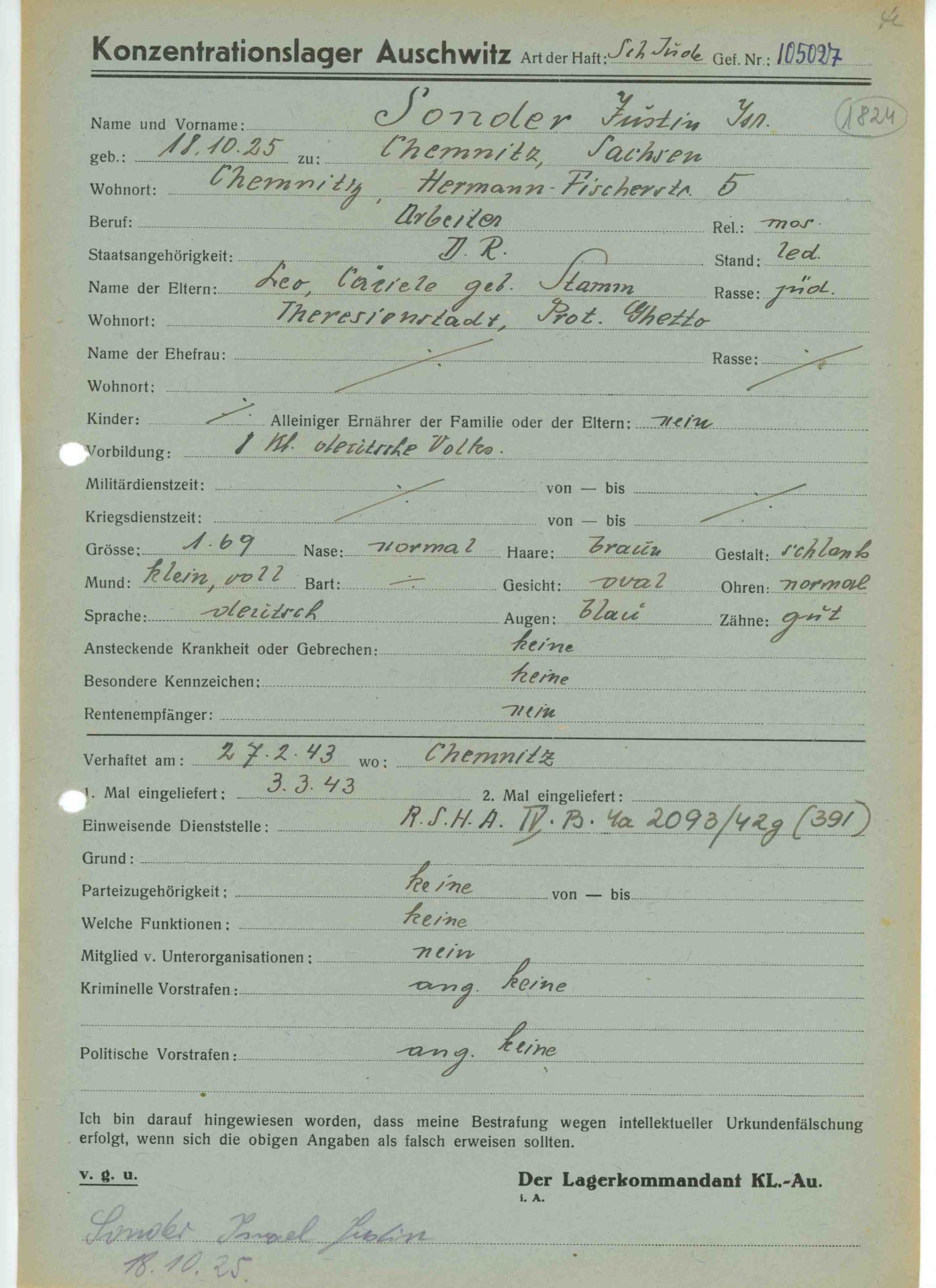
From April to October 1941, he lived in Berlin and began an apprenticeship as a cook. Upon his return to Chemnitz, he was immediately forced to perform hard labour at the E. F. Barthel lighting fittings factory in Altchemnitz, where he was assigned to the die-casting shop. He was also forced to move into the “Judenhaus” at 74 Zschopauer Straße, and later to the “Judenhaus” at 5 Hermann-Fischer Straße (formerly Zimmerstraße, now built over).
On 27 February 1943, Justin Sonder was arrested and, a few days later, deported via the “Judenlager” Hellerberg near Dresden to Auschwitz.
Liberation
He remained in the camp until 18 January 1945 – he survived by working as a metalworker and was assigned to the mine and transport detail. He endured the subsequent death marches, including those to Sachsenhausen, Flossenbürg and Natzweiler, before being liberated by the US Army in Wetterburg near Regensburg.
On 9 June 1945, he returned to Chemnitz with his father Leo.
Back in Chemnitz
In Chemnitz, Sonder joined the SPD and helped found the Jewish Community. In October 1945, he became a probationary constable, and subsequently a sergeant in Chemnitz. In 1947, he was transferred to the Criminal Investigation Department. On 18 October 1950, he resigned from the Jewish Community.
In 1952, he married Marga Uhlig, with whom he had three children.
For a short time, he held a senior position in the Criminal Investigation Department. In the 1960s, he studied law at Humboldt University in Berlin and later became head of the serious crimes division in Chemnitz.
In 1987, he testified before the Dresden District Court in the trial of former SS officer and Gestapo commissioner Henry Schmidt, who had organised the deportations from Dresden.


Honorary Citizenship and a bank
In April 2017, he was awarded honorary citizenship of the city of Chemnitz. His wife passed away in the same year. He last lived at 57 Ulmenstraße (Kaßberg). He died on 3 November 2020 in Chemnitz at the age of 95 and was buried in the Municipal Cemetery.
In his honour, a memorial bench will be unveiled on 9 November 2024 on Chemnitz’s Brühl.

