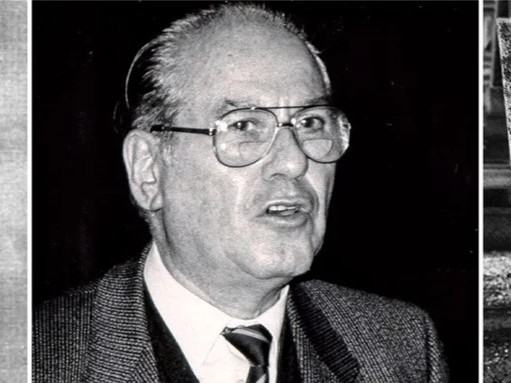
Adolf Diamant
From Auschwitz to Palestine and Frankfurt
* 18.04.1924 in Chemnitz
✡ 23.05.2008 in Frankfurt (Main)

Life and Work
Adolf Diamant was born in 1924 to Hermann (Hersz) Diamant and Lore Silberstein, a merchant couple of Polish nationality. He attended the Bernsbach School on Bernsbachplatz and lived at 47 Zschopauer Straße. On 10 April 1937, he celebrated his bar mitzvah at the synagogue on Stephanplatz; a year later, he began his training at the Technical School in Chemnitz. After being expelled from school by the Nazi regime, he started an apprenticeship as a mechanic at the knitting machine factory Sander & Graff AG, which he, however, abandoned a few years later.
Life under National Socialism
On 28 October 1938, Adolf Diamant was deported from Chemnitz to Poland, together with his parents and 335 other people. He found refuge with relatives in Łódź and was later forced to move with his parents to the Litzmannstadt ghetto. His parents were murdered in Auschwitz.
Adolf Diamant was also deported to Auschwitz. In 1944, he was transferred to Braunschweig and the Salzgitter-Watenstedt concentration camp. In Braunschweig, he was put to forced labour for Büssing AG. He was later sent to the camps at Sachsenhausen, Oranienburg, Ravensbrück and, finally, Wöbbelin near Schwerin. The Wöbbelin concentration camp was liberated by US troops on 2 May 1945 and Adolf returned to Chemnitz.
Back in Chemnitz
His new address is 22 Fichtestraße. In September, he helps to found the Jewish Community of Chemnitz. He works as an interpreter at Chemnitz Police Headquarters (Precinct 14), but moves to Berlin in November 1946 due to political disagreements with the police. In the summer of 1947, he leaves Germany and emigrates to Palestine. There, he joins the Israeli army in 1948 and takes part in the War of Independence.
In 1957, he returns to Germany. In Frankfurt am Main, he worked as a journalist. On 15 November 1965, he married Maria Montag, with whom he remained in a relationship until her death in 2000. Meanwhile, in Chemnitz, a memorial stone was erected in 1967 at the Jewish Cemetery in memory of his murdered parents and 20 other family members. In 1961, he was questioned as a witness during the preliminary investigations for the Frankfurt Auschwitz trial. He also brought a case against the Büssing Group, for whom he had been forced to perform labour. In the 1965 judgement, he was awarded compensation, which ultimately amounted to only 177.80 marks.
Diamant became a member of the Commission for the History of the Jews in Hesse. From 1970 onwards, he published works on the regional and local history of the Jews and the Gestapo in Germany, focusing on Saxony and Hesse, including the “Chronicle of the Jews in Chemnitz, now Karl-Marx-Stadt” (1970). He amassed over 300,000 items in his private archive. Today, it is housed at the Centre for Research on Anti-Semitism in Berlin.
In November 1988, he took part in the commemorative ceremonies marking the 50th anniversary of the November pogroms in Karl-Marx-Stadt and gave a lecture at St John’s Church. In 2000, the Jewish Community of Chemnitz acquired Adolf Diamant’s library. In May 2002, he was invited as a guest of honour by the Jewish Community and the City of Chemnitz to the inauguration of the New Synagogue on Kapellenberg.
He died in Frankfurt (Main) in May 2008 and, alongside his wife is buried in the New Jewish Cemetery.